How-to · Canada
Leaf Blower or Rake: What Works Best for Fall Cleanup?
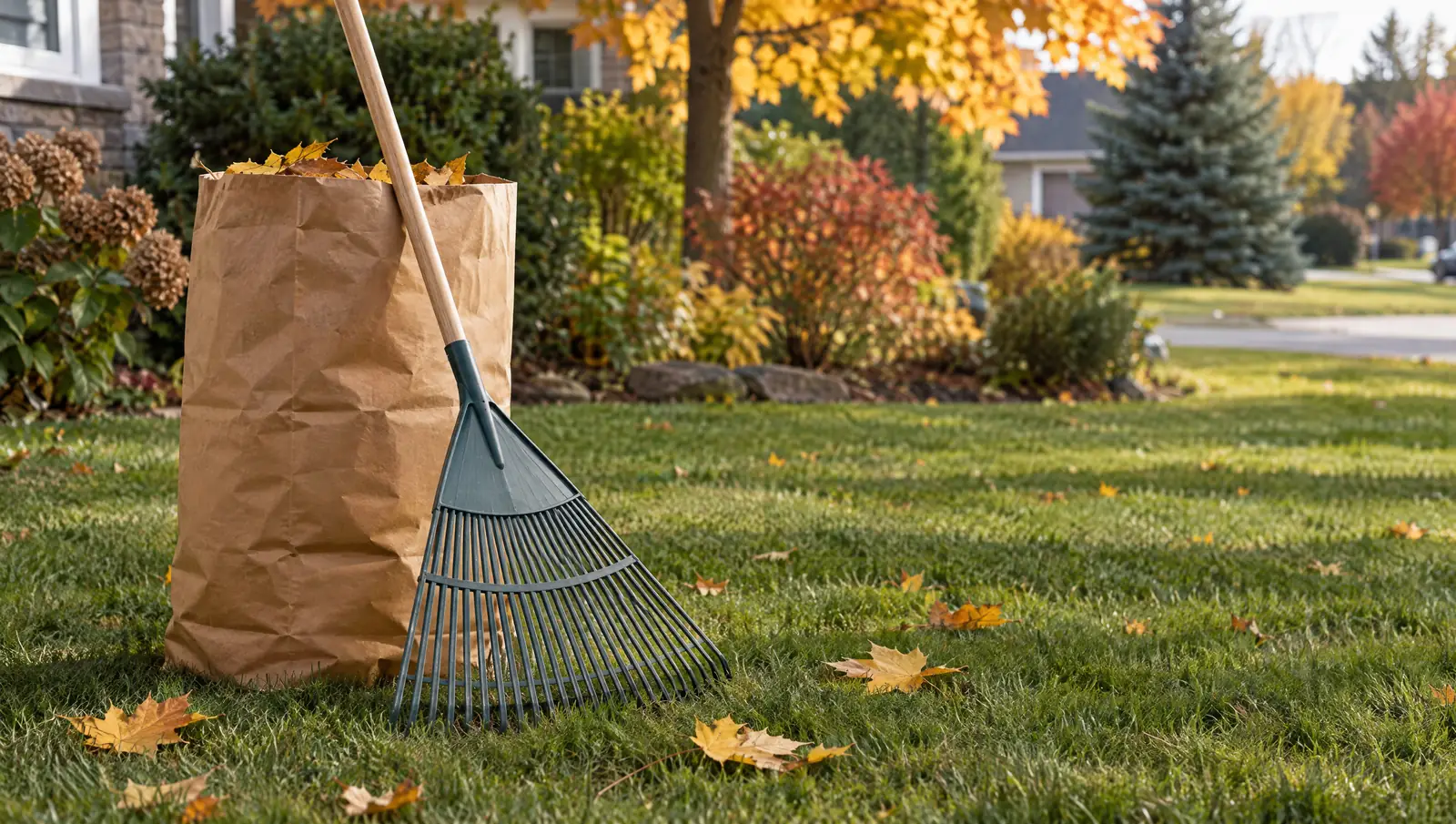
Use a rake for a small yard and for wet, matted leaves. Use a leaf blower for a big lawn, garden beds, gravel and hard surfaces like the driveway. Most Canadian yards do best with both: blow the leaves into rows, then rake or bag them. If you have a blower, wear eye and hearing protection, and check your city's noise rules first.
Is a leaf blower faster than a rake?
On a big, open lawn with dry leaves, yes. A blower moves a lot of leaves without bending. You walk, aim and push them into a pile.
On a small lawn, the gap gets small. You spend time starting it, finding a plug or filling the tank. By then, a rake has done half the job.
Wet leaves change everything. They stick to the grass and to each other. A blower struggles to lift a wet mat. A rake pulls it free.
So speed depends on three things:
- Yard size. Bigger lawns favour the blower.
- Leaf condition. Dry and loose favours the blower. Wet and matted favours the rake.
- Where the leaves sit. Open grass suits both. Beds, gravel and corners suit the blower.
Do you even need to move every leaf?
No, and that might save you the whole debate. The University of Wisconsin Extension uses a simple scale:
- About 20% of the lawn covered: you can ignore them.
- About 50% covered: you still don't need to rake. Mow over them to chop them up.
- Grass barely shows: rake or remove at least half. Then mow the rest and leave them on the lawn.
So if your leaf drop is light, the mower may be the only tool you need. We covered that in mulching leaves with a lawn mower. For the heavy part of the season, see should you rake leaves before winter.
Iowa State University Extension lists three ways to lift a thick layer off the lawn: raking, blowing, or the bag on your mower. All three work. The trick is picking the right one for each part of the yard.
When is a rake the better choice?
A rake is cheap, quiet and never runs out of gas. It's the better tool in these cases:
- Small yards. A townhouse or city lot is often done faster by hand.
- Wet or packed leaves. After rain or a frost, leaves mat down. Tines pull them up.
- Thin grass. A light leaf rake is gentle. A strong blast of air can kick up loose soil.
- Early mornings. You won't wake the street.
- Windy days. A blower fights the wind. A rake and tarp don't care as much.
Use a wide leaf rake with springy tines, not a stiff garden rake. Rake onto a tarp, then drag the tarp to your bags or beds. It beats lifting armfuls.
When is a leaf blower the better choice?
A blower shines where a rake can't reach or doesn't grip:
- Large, open lawns with a heavy, dry leaf drop.
- Garden beds and mulch. Air lifts leaves out without dragging the mulch along.
- Gravel, stone and pavers. A rake pulls stones. Air leaves them in place.
- Under hedges and shrubs. Leaves pile up deep under branches.
- Driveways, decks and steps. A quick pass clears them in a few minutes.
- Fence lines and corners where leaves get trapped.
The blower is a moving tool, not a pickup tool. You still need to bag, compost or haul the pile. Plan for that part before you start.
How loud is a leaf blower?
Loud. The City of Montréal says leaf blowers can make 80 to 115 decibels. It gives two examples. 80 decibels is like a street with heavy traffic. 100 decibels is like a jackhammer 2 metres (about 6.5 feet) away.
The City also says noise over 85 decibels can cause hearing damage in the person using the tool. The Canadian Centre for Occupational Health and Safety (CCOHS) recommends hearing protection for leaf blowers. Earplugs or earmuffs are a small price for your hearing.
The noise also hits your neighbours. That's why many cities limit when you can run one.
Are leaf blowers banned anywhere in Canada?
Some places limit them. In Montréal, the borough of Côte-des-Neiges and Notre-Dame-de-Grâce changed its noise bylaw on June 7, 2022. Here's what it says:
| Blower type or time | Rule in that borough |
|---|---|
| Gas blowers with a two-stroke engine | Not allowed at any time |
| Other blowers, June 1 to September 30 | Not allowed at any time |
| Other blowers, October 1 to May 31, Monday to Friday | Allowed 7 a.m. to 7 p.m. |
| Other blowers, October 1 to May 31, Saturday | Allowed 10 a.m. to 7 p.m. |
| Sundays and public holidays | Not allowed |
The same page names other places with blower rules: the Verdun, Outremont and Ville-Marie boroughs, plus Beaconsfield and Westmount. The borough also urges people to use brooms and rakes.
Most Canadian cities don't ban blowers outright. But nearly every city has a noise bylaw with quiet hours for power tools. Look up yours before you plan an early Saturday start.
How do you use a leaf blower safely?
CCOHS warns that leaf blowers can throw objects that hurt the user and other people. Its safety tips are simple:
- Clear a circle. Keep people, pets and objects about 10 metres (30 feet) away.
- Wear eye protection every time. CCOHS says even small stones can blind a person.
- Protect your hearing. Earplugs or earmuffs.
- Wear a mask in dusty spots. Damp, rotting leaves can hold mould, and the spores are a breathing hazard.
- Aim away from people, pets and glass. Hard objects can make debris bounce back at you.
- Keep the tube on. Never run the blower without it.
- Stay on the ground. Never use a blower from a ladder, a tree or the roof.
Montréal adds one more reason for care. The air jet stirs up fine particles and dust, which can make asthma worse. If someone in the house has asthma, close the windows first.
What's the best way to use both?
Here's a plan that works on most yards:
- Walk the yard and pick up sticks, toys and stones.
- On a dry day, blow leaves out of beds, from under shrubs and off the driveway onto the lawn.
- Blow or rake the lawn leaves into long rows.
- Rake the rows onto a tarp, then bag them or move them to your compost.
- Rake any wet, matted spots by hand.
- Run the mower over what's left to chop it up.
Keep leaves out of the street and off your neighbour's lawn. Blown leaves land wherever the air sends them.
The edges need a final touch too. A clean line along the walk and beds is part of trimming and edging. Grass is still growing in early fall, so keep up with how often to mow in Canada until it stops.
Can someone else handle the leaves?
Yes. Golden Oak Lawn Care matches you with a vetted, insured local crew in your city. They do the work. We stand behind it with the Golden Oak Guarantee.
A fall cleanup clears leaves from the lawn, beds and edges. Your crew bags them, moves them to your compost or hauls them away, your choice. Book weekly lawn mowing too, and your crew chops light leaf drops as the season goes.
We price every yard from satellite images, so no one needs to visit. Lawn size, leaf volume, beds, slopes, gates and haul-away all change the price.
Want it handled? Get your price in 60 minutes, or call 1-866-904-LAWN.
Leaf Blower and Rake Questions
Is a leaf blower bad for the lawn?
Not if you use it with care. Keep the nozzle moving and don't blast bare soil or thin spots. On wet, matted leaves, a rake does a better job anyway.
Can a leaf blower move wet leaves?
It struggles. Wet leaves are heavy and stick to the grass. Wait for a dry day, or rake the wet patches by hand.
Do I need hearing protection for a leaf blower?
Yes. CCOHS recommends it. The City of Montréal says blowers can reach 80 to 115 decibels, and noise over 85 decibels can damage the user's hearing.
Should I rake or blow leaves in a small yard?
A rake is usually enough. It's quiet and needs no fuel or charging. Keep a blower for the driveway, beds and gravel if you own one.
Rules change, so check with your city before you plan. Sources: CCOHS leaf blower safety, City of Montréal leaf blower rules, University of Wisconsin Extension, Iowa State fall lawn care.