How-to
Weed Whacking Around Fences, Trees and Beds: Tips That Work
 Illustration
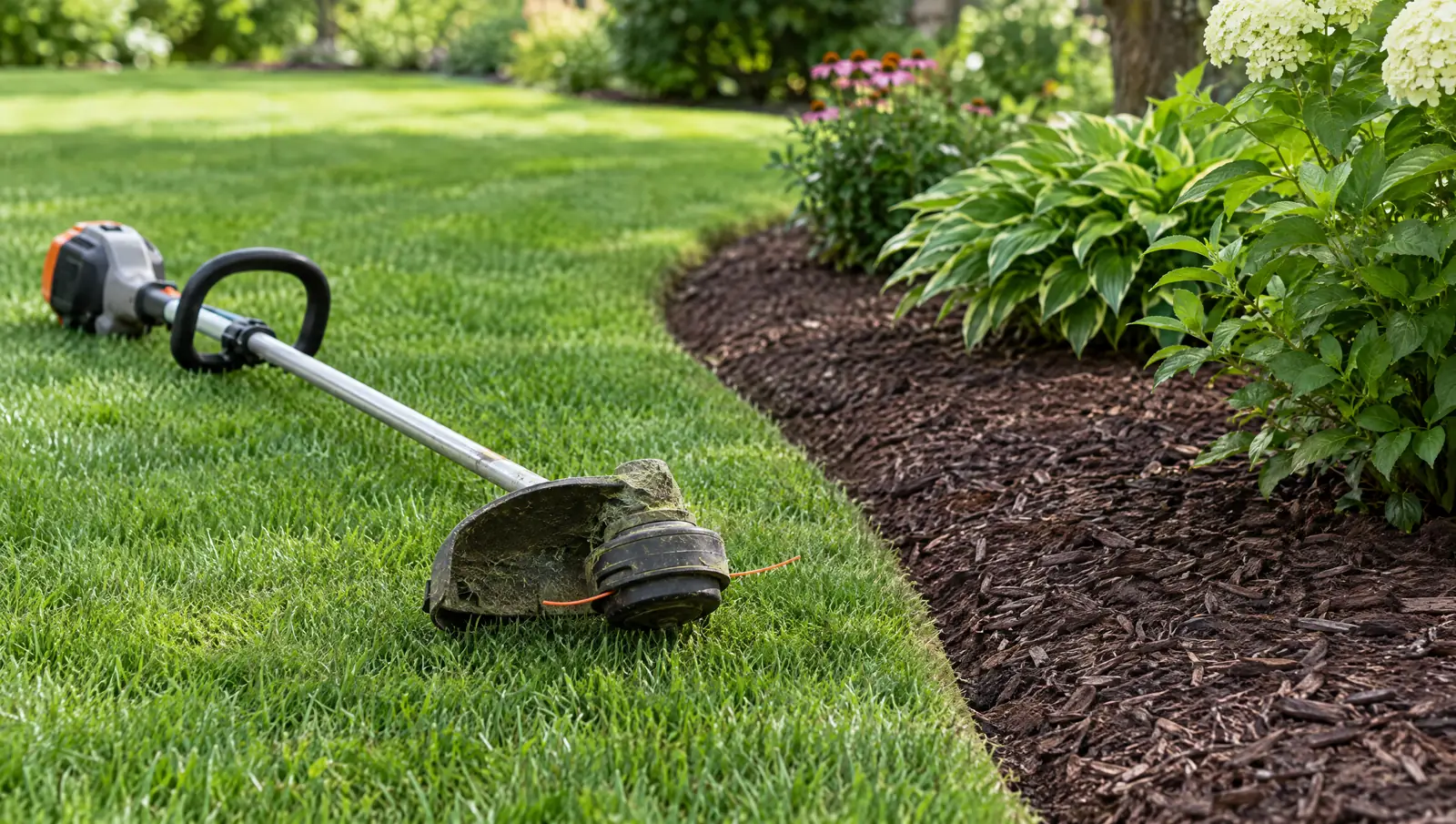
Good weed whacking comes down to three habits. Clear the yard of stones first. Use only the tip of the line, and walk slowly with the head close to level. Along fences and beds, let the line just kiss the edge. Around trees, don't trim at the trunk at all. Put a mulch ring there instead, so the line never touches bark. Wear long pants, gloves and eye protection every time.
What gear do you need before you start?
A string trimmer throws grass, dirt and stones hard and fast. The Canadian Centre for Occupational Health and Safety (CCOHS) says rotating cutters can throw objects or cut the person using them. Dress for that. CCOHS lists:
- Jeans, overalls or long pants. No shorts and no short sleeves.
- Heavy-duty gloves that don't slip.
- Safety boots with non-slip soles.
- Safety goggles, or a face screen over safety glasses.
- Ear muffs or ear plugs.
Then check the tool. CCOHS says the guard and shields must be in place and working. The cutting head should be tight. Swap out a bent or damaged head. Read the owner's manual once, too. It tells you how to feed line and which way your head spins.
How do you get the yard ready to trim?
Walk the whole trim line before you pull the cord. It takes five minutes and saves a cracked window.
- Pick up stones, glass, metal, toys and sticks. CCOHS says to clear all of them.
- Bring kids and pets inside. CCOHS says to keep people away from where you start and run the tool.
- Move bikes, planters and cars away from the area.
- Flag sprinkler heads, garden lights and low cables near the edges.
- Close windows on the side of the house you're trimming.
Pick a dry day if you can. The City of Red Deer says wet grass clumps together. Wet clippings also stick to fences, siding and your legs.
Start a gas trimmer on firm, open ground, as CCOHS advises. Fuel it while the engine is cool. If you run out halfway, let it cool before you refill.
How should you hold and move a weed whacker?
Most bad trimming comes from holding the tool wrong. Try these habits:
- Hold it with both hands. CCOHS says to grip it firmly with two hands and keep your footing.
- Set the harness and handle. Adjust them so the head sits just above the grass when you stand straight.
- Cut with the tip. The last few centimetres of line do the work. Pushing the whole head into grass slows the line and bogs the motor.
- Keep the head level. A tilted head digs in and scalps a brown strip into the lawn.
- Walk slowly. Sweep side to side in small arcs. Take a step, then sweep again.
- Don't reach. CCOHS says never overreach. Step closer instead.
Your goal is grass at the same height as the mowed lawn. If the trim line is lower than the rest, you'll see a pale stripe for a week.
How do you weed whack along a fence?
Fences are where most people eat line and scar boards. Go slow here.
- Let the line just touch the fence. The tip should flick the grass at the base. Don't jam the head against the boards.
- Watch your fence type. Wood, vinyl and painted posts all mark easily. Chain link chews through line fast.
- Mind the posts. Slow down at each post and work around it in a short curve.
- Reach under, not through. For grass under a chain-link fence, tilt the head a little and trim from your own side.
- Check the other side. If grass grows through from the neighbour's yard, just trim what's on your side.
The same rules work along the house. Siding, window wells, dryer vents and the air conditioner all sit right at trim height. Keep the guard between you and the line, and give them a little room.
How do you weed whack around trees without hurting them?
This is the one spot where less trimming is better. The City of Burlington says to keep lawn mowers and string trimmers away from the tree stem. It says the injuries weaken the trunk and open the tree to insects and disease. Severe bark damage can kill the tree.
University of Illinois Extension explains how it happens. The line rubs the bark again and again. Over time, it cuts into the living layer under the bark. That damage is hard for a tree to recover from.
Use a mulch ring instead of trimming the trunk
Kansas State University says a mulch ring keeps string trimmers and mowers from getting too close to the trunk. University of Illinois Extension gives these numbers:
- A ring that reaches 60 to 90 cm (2 to 3 feet) out from the trunk is enough.
- Spread the mulch 5 to 10 cm (2 to 4 inches) deep at most.
- Keep the mulch about 2.5 cm (1 inch) back from the trunk.
Once the ring is in, you only trim the outside edge of the circle. The line never gets near the bark. It's the same idea we cover in how to edge a lawn.
How do you trim next to garden beds?
Beds are tricky because the line can't tell grass from flowers. A few tips:
- Face the head so clippings fly onto the lawn. Check which way your head spins. Then pick the side of the bed that throws grass out, not in.
- Trim the lawn side only. Keep the tip right at the line where turf stops.
- Slow down near soft stems. Hostas, lilies and young shrubs shred in one touch.
- Keep rigid blades out. CCOHS says not to use rigid blades in stony areas. Rock beds and stone borders are a string-only job.
Weeds growing up inside the bed itself? Our partner crews don't spray, and Golden Oak gives no weed killer advice.
Should you trim before or after you mow?
Many people trim first. Then the mower picks up some of the clippings on its pass. Others mow first, so the trim height is easy to match. Both work fine.
What matters is doing it on every mow. Trim lines grow as fast as the rest of the lawn. Skip a few weeks, and you're cutting thick, tall grass that wraps the head. Our guide to how often to mow gives you the rhythm to follow.
How do you clean up after weed whacking?
A trim job isn't done until the hard surfaces are clean.
- Blow or sweep clippings off the walk, driveway and patio.
- Push them back onto the lawn. The City of Red Deer says to sweep clippings away from the storm drain.
- Using a leaf blower? CCOHS says to wear eye protection and keep about 10 metres (30 feet) clear of people and pets.
- Aim the blower away from cars, windows and people, so stones don't bounce back.
- Shut the engine off before you pull out wrapped grass. CCOHS says to never clear a clog while it runs.
Never leave the trimmer running on the lawn while you grab a drink. CCOHS says not to leave running equipment alone.
Can a local crew do the trimming for you?
Yes. Golden Oak Lawn Care matches you with a vetted, insured local partner crew. They do the work. We stand behind it with the Golden Oak Guarantee.
Your crew handles trimming and edging on the same visit as your lawn mowing. That means fences, walls, posts, trees, beds and the mailbox. They blow the clippings off hard surfaces and text you a photo when they're done. Not happy? Text us a photo within 24 hours. Your crew re-cuts it free within 48 hours.
We price every lawn by its size from satellite images, so no one needs to visit. Long fence lines, lots of trees and beds, slopes and gates all change the price.
Want it handled? Get your price in 60 minutes, or call 1-866-904-LAWN.
Weed Whacking Questions
Is it OK to weed whack right up to a tree?
No. The City of Burlington says to keep string trimmers away from the tree stem. Bark damage weakens the trunk and can kill the tree. A mulch ring around the base gives you nothing to trim near the bark.
Why does my weed whacker leave brown strips?
The head is tilted, so the line cuts too low. Hold the head level and cut with the tip of the line. Aim for the same height as the mowed lawn.
Do I need safety glasses to weed whack?
Yes. CCOHS says to wear safety goggles, or a face screen over safety glasses. It also lists long pants, gloves, non-slip boots and hearing protection.
Should I weed whack when the grass is wet?
It's better to wait. The City of Red Deer says wet grass clumps together. Wet clippings stick to fences and siding, and the line clogs more often.
Sources: CCOHS grass trimmers and brush cutters, City of Burlington Guide to Tree Protection, University of Illinois Extension mower and weed-eater damage, Kansas State University mulch rings, City of Red Deer grasscycling.