How-to
How to Edge Flower Beds for a Clean, Sharp Line
To edge a flower bed, lay a garden hose along the line you want. Push a sharp flat spade or a half-moon edger straight down along it. Then lift out the grass and soil to leave a small, clean step. University of Illinois Extension says a gap 10 cm (4 inches) deep and wide can easily hold back bluegrass. Re-cut the edge once or twice a year. Keep a strip of bare soil between the mulch and the lawn.
How is edging a flower bed different from edging a lawn?
Along a sidewalk, the concrete does half the work. It gives you a straight line to follow. A flower bed has no line until you make one.
A bed edge is also a small dig, not just a trim. You cut down into the soil and take out a strip of grass. What's left is a little step between the lawn and the bed. Illinois Extension calls it "a small cliff."
That step does two jobs. It shows a clear line where the lawn ends. It also slows grass down on its way into your flowers. For walks and driveways, see our guide on how to edge a lawn. For what a crew does on each visit, see trimming and edging.
Why does grass keep creeping into your flower beds?
Grass doesn't stay put. Illinois Extension says grass grows toward and into beds about 7.5 to 10 cm (3 to 4 inches) a year.
A lot of that spread happens under the soil. Kansas State University Research and Extension says Kentucky bluegrass spreads by underground stems called rhizomes. Our post on Kentucky bluegrass lawn care covers that grass in more detail.
So a quick pass with a string trimmer only cuts the tops. The stems below keep moving into the bed. A real cut edge leaves an open gap with no grass in it. Illinois Extension says a gap 10 cm (4 inches) deep and wide can easily contain bluegrass.
What tools do you need to edge a flower bed?
You don't need much. Most of it is already in the garage.
- A garden hose or a long rope to lay out curves. Penn State Extension uses an old hose for this.
- String and two stakes for a straight edge. Penn State uses a measuring tape and stakes for straight beds.
- Marking paint, the kind that sprays upside down. Penn State marks the edge with it before digging.
- A sharp flat spade or a half-moon edger. Penn State says both work well. Illinois says to use a sharp spade.
- A tarp or a wheelbarrow to hold the strips of grass you lift out.
- Gloves and sturdy boots. You'll be stepping on the spade a lot.
A dull spade tears the turf and leaves a ragged line. Take a file to the blade first if it's been a few years.
How do you edge a flower bed, step by step?
Pick a day when the soil is damp but not soggy. Dry, hard soil fights the spade. Wet soil sticks to it and smears.
- Lay out the line. Set the hose where you want the edge. Step back and look at it from the street and the house. Move it until it looks right.
- Mark it. Spray a light line of marking paint along the hose. Then move the hose out of the way.
- Cut the lawn side first. Set the spade on the line with the flat face toward the lawn. Step it straight down, about 10 cm (4 inches).
- Keep going. Pull the spade out, move it along and cut again. Overlap each cut a little, so there are no gaps.
- Dig out the strip. Work from the bed side. Slide the spade in at an angle toward your first cut. Lift out the wedge of grass and soil.
- Check the step. You want a clean wall on the lawn side and an open gap about 10 cm (4 inches) wide.
- Shake out the soil. Knock loose soil off the grass roots and back into the bed.
- Smooth the bed side. Rake the soil so it slopes gently up from the gap to your plants.
How deep should a flower bed edge be?
Go for about 10 cm (4 inches) deep and 10 cm wide. That's the size Illinois Extension says can easily contain bluegrass.
Penn State Extension goes a bit deeper for a brand new bed. It digs the edge 10 to 15 cm (4 to 6 inches) deep. Never cut this edge before? Has grass grown far into the bed? Then the deeper cut is a good first pass. After that, a 10 cm step is easy to keep up.
Don't go much shallower than that. A thin, shallow gap fills in fast, and you're back where you started.
How should you shape the curves?
Big, gentle curves look better and they're easier to keep. Tight wiggles are hard to cut and hard to mow along.
Here's a quick test. Push your mower along the hose before you cut. If the mower can't follow the curve without backing up, open the curve up.
Give your plants room too. Illinois Extension says bed lines that are too close to plants can make the bed look tight. Shrubs and perennials get bigger every year. Leave space for them to fill out.
Shrubs already hanging over the edge? Trim them back before you cut the line, so you can see where it goes. A hedge and shrub trim pairs well with a fresh bed edge.
Where should the mulch stop?
Not right at the grass. Illinois Extension says to leave some open dirt between the mulch and the lawn edge. It says that makes touch-up edging easy and keeps grass from moving into the mulch.
Watch the depth too. Illinois gives these numbers:
- Flower beds: about 2.5 cm (1 inch) of mulch once it settles.
- Shrub and evergreen beds: 5 to 7.5 cm (2 to 3 inches) is common.
- Perennials: don't pile mulch on the crown. Many perennials grow back from the crown each year and can't push up through mulch.
If the mulch sits higher than the lawn, it spills into the grass after every rain. Keep the top of the mulch below the step you cut.
Do you need plastic or metal edging?
No. A cut edge on its own looks clean and costs nothing but time. Illinois Extension says a hand-edged bed is hard work, though, and needs a touch-up once or twice a year.
Store-bought edging has its own problems in a Canadian winter. Illinois Extension says steel edging has trouble with frost heaving. It says plastic edging has poor durability and often won't stay in the ground.
Illinois also points out that beds change. Edging laid down today can end up under shrub branches in a few years. A cut edge can move out with the bed as your plants grow.
One note: our partner crews keep cut edges sharp. They don't install edging, stone or borders.
When is the best time to edge flower beds?
Fall is a great time. Illinois Extension suggests putting in a new edge on your beds in the fall. Once your perennials die back, you can see the line clearly. Cut it before the ground freezes. Once the soil is frozen hard, wait for spring.
Spring is the other good window. Once the snow is gone and the soil is firm, re-cut the step. Grass that crept in over the summer gets cut off.
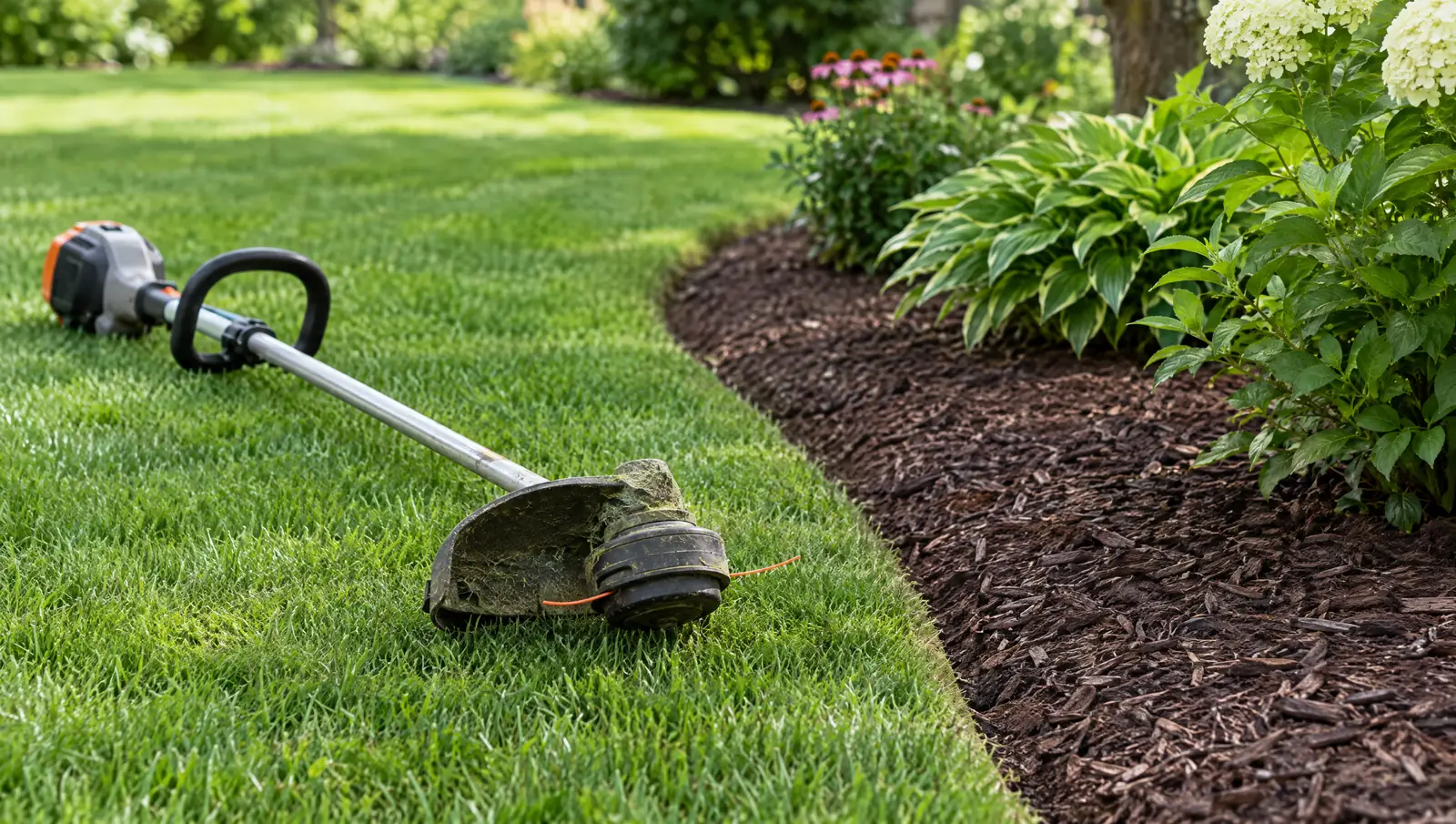
Between those two cuts, a light pass with a string trimmer keeps the line neat. Do it on the same day as your lawn mowing. The trimmer won't dig the gap, but it stops grass blades from flopping over it.
What do you do with the cut strips of sod?
You'll lift out a fair bit of grass and soil. Don't just toss it in a yard waste bag. Many cities won't take it.
- Hamilton: the City says no rocks, sod or soil in yard waste. Bags with sod can get an orange "Oops!" sticker.
- Region of Waterloo: no soil, dirt or sod in yard waste.
- Airdrie: sod can go in the green organics cart. The City says to fill the cart only half full, because of weight limits.
Check your own city's yard waste page before you bag it. A compost pile in the back corner works well too. Stack the strips grass side down and let them break down.
Weeds coming up in the bed? Our partner crews don't spray, and Golden Oak doesn't give weed killer advice.
Can a local crew keep your bed edges sharp?
Yes. Golden Oak Lawn Care matches you with a vetted, insured local partner crew. They do the work. We stand behind it with the Golden Oak Guarantee.
Your crew trims along your beds, walks and driveway on each mowing visit. A spring or fall cleanup clears leaves out of the beds and trims the edges too. After every cut, your crew texts you a photo. If the edges look sloppy, text us a photo within 24 hours. Your crew re-cuts it free within 48 hours.
We price every lawn by its size from satellite images, so no one needs to visit. The number of beds, the length of the edges and gates all change the price.
Want it handled? Get your price in 60 minutes, or call 1-866-904-LAWN.
Flower Bed Edging Questions
How often should I edge my flower beds?
Cut a full edge once or twice a year, in spring and fall. Illinois Extension says grass grows 7.5 to 10 cm (3 to 4 inches) into beds each year. A light trimmer pass when you mow keeps it neat in between.
Can I edge a flower bed with a string trimmer?
Only for upkeep. A trimmer cuts the grass blades, but it doesn't dig the gap. Use a sharp spade or a half-moon edger to cut the step, then use the trimmer to keep it tidy.
How deep should I cut a garden bed edge?
About 10 cm (4 inches) deep and 10 cm wide. Illinois Extension says a gap that size can easily contain bluegrass. For a brand new bed, Penn State Extension digs the edge 10 to 15 cm (4 to 6 inches) deep.
Should mulch go right up to the lawn?
No. Illinois Extension says to leave some open dirt between the mulch and the lawn edge. That keeps grass out of the mulch and makes the next edge easy to cut.
Yard waste rules change, so check with your city before you bag sod. Sources: Illinois Extension edging and mulching beds, Illinois Extension bed edges, Penn State Extension new bed edges, K-State Kentucky bluegrass, City of Hamilton yard waste, Region of Waterloo yard waste, City of Airdrie organics.